
Africa Centre of Excellence in Coastal Resilience |  University of Cape Coast


Development Challenges
"If we wipe out the fish, the oceans are going to die. If the oceans die, we die."
Paul Watson
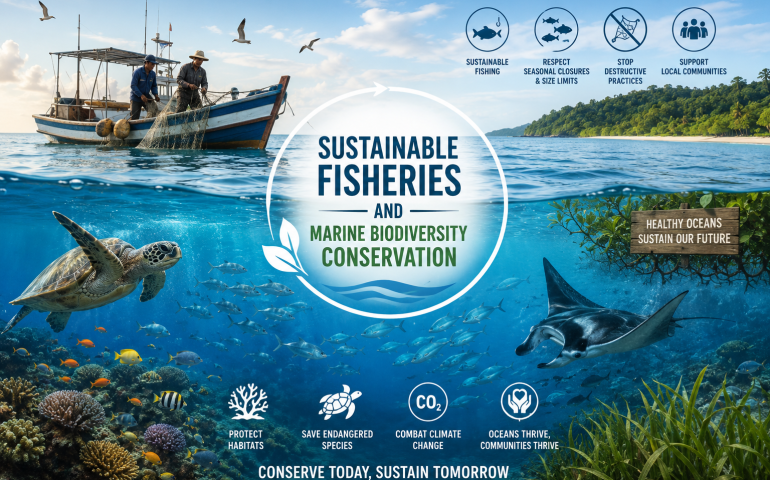
Sustainable fisheries refer to the exploitation of fish resources at rates that allow populations to replenish, ensuring long-term viability without degrading marine habitats or ecosystems. The primary challenge lies in reconciling food security, livelihoods, employment, and ecological health. Achieving this balance requires strong governance, data-driven and science-based management, effective community participation and climate change adaptation responses. Key challenges facing sustainable fisheries and marine biodiversity in Ghana and Africa as a whole include overfishing; illegal, unreported and unregulated (IUU) fishing; destructive fishing practices; habitat destruction and coastal development; climate change; and pollution. These challenges emanate from inadequate and unreliable data, socio-economic pressures, low stakeholder awareness and compliance, as well as weak governance and poor enforcement mechanisms.
The overarching goal of this theme is to promote the sustainable utilisation of fish resources while strengthening biodiversity conservation in Ghana and the sub-region. This will be achieved through demand-driven and policy-driven research activities, education, and awareness creation; science-based and ecosystem-based fisheries management; and formulation and revision of legal and governance frameworks.
Objectives
Sustainable Fisheries
• Maintain fish stocks at biologically sustainable levels
• Prevent overfishing and stock collapse
• Reduce bycatch and discards
• Strengthen compliance with fisheries laws, policies and regulations
• Promote responsible and selective fishing practices
• Improve operational efficiency and reduce post-harvest losses
• Ensure equitable access to fisheries
• Enhance data collection and scientific research to inform policies
Marine Biodiversity Conservation
• Conserve critical habitats (including mangroves, coral reefs, and seagrass beds) and maintain ecosystem functions
• Control coastal pollution and habitat destruction
• Restore degraded marine ecosystems
• Improve ecosystem resilience to climate change
• Establish and manage marine protected areas (MPA)
• Promote ecosystem-based management approaches
• Safeguard ecological services provided by marine ecosystems
Research Areas
Sustainable Fisheries
• Fish stock assessment and population dynamics
• Fisheries ecology and ecosystem dynamics
• Fishing gear technology and selectivity
• Fisheries governance, policy and institutional frameworks
• Climate change and fisheries interactions
• Socio-economic and livelihood studies
• Small-scale and industrial fisheries research
• Post-harvest fisheries and value addition
• Fisheries data, monitoring and technology
• Economics of fisheries management
Marine Biodiversity Conservation
• Conservation and management research
• Human impacts and threat assessment
• Habitat and ecosystem research (corals, seagrass, mangrove, etc.)
• Socio-economic and governance research
• Climate change and nature-based solutions research
• Technology, data and innovation
Expected Outcomes
The outlined research areas are interrelated and will jointly produce outcomes that enhancefood security and nutrition, promote sustainable livelihoods and employment, and supporteconomic growth and national development, among others. These benefits align with thegoals of national, regional and global fisheries policies and laws, including the GhanaFisheries and Aquaculture Act, 2025 (Act 1146); the African Union’s Policy Framework andReform Strategy for Fisheries and Aquaculture in Africa (PFRS); the Agreement on Port StateMeasures (PSMA); the Voluntary Guidelines for Securing Sustainable Small-Scale Fisheries inthe Context of Food Security and Poverty Eradication (SSF Guidelines); the 2030 Agenda forSustainable Development, particularly SDG 14; and the FAO Code of Conduct forResponsible Fisheries.